











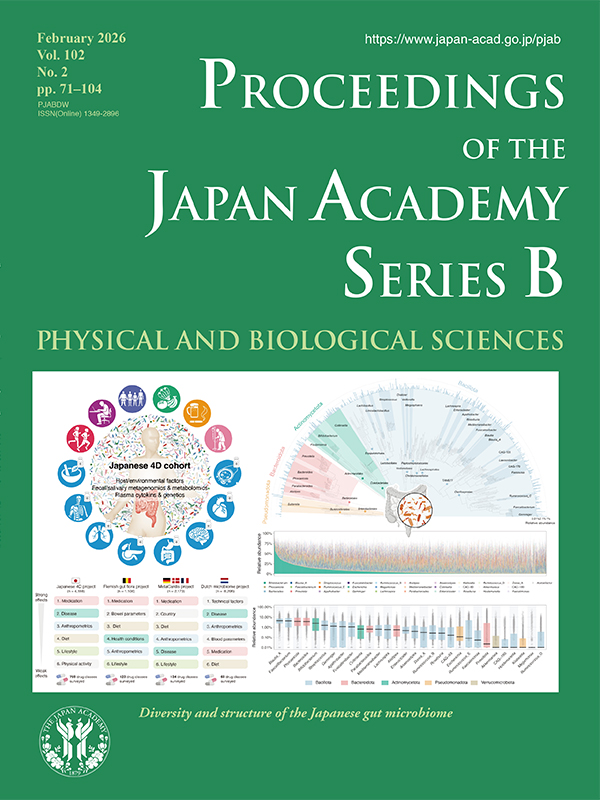
The cover image illustrates the ecological structure and population-level diversity of the Japanese gut microbiome, as reviewed by Nishijima, Hattori, and Nagata (pp. 82–103). While early microbiome research was often constrained by small cohort sizes and limited analytical resolution, recent advances in large-scale, standardized metagenomic approaches have enabled a more comprehensive and comparable understanding of human gut microbial ecosystems. The visualization on the right is primarily based on shotgun metagenomic data from the Japanese 4D microbiome cohort, one of the world’s most extensive and rigorously standardized population-based studies, comprising over 5,000 individuals.
The top panel presents a phylogenetic tree summarizing major bacterial lineages in the Japanese gut microbiome, highlighting broad evolutionary diversity across dominant phyla such as Bacillota, Bacteroidota, Actinomycetota, and Pseudomonadota. Representative genera with well-established roles in human health—including Bifidobacterium, Faecalibacterium, Blautia, and Bacteroides—are distributed across distinct branches, illustrating that key functional members of the gut microbiome arise from multiple evolutionary backgrounds.
The middle panel depicts the relative abundances of major bacterial genera at the population level, capturing microbial features commonly shared among Japanese individuals. In contrast, the bottom panel emphasizes substantial inter-individual variability, underscoring that each person harbors a distinct gut microbial ecosystem despite overarching population-level patterns.
By integrating these data with comparative analyses of more than 25,000 gut metagenomes from over 36 countries, the review synthesizes global evidence to demonstrate how large, well-standardized studies can simultaneously reveal universal features of the human gut microbiome and population-specific characteristics shaped by diet, culture, genetics, and environment. Notable examples include the consistently high abundance of Bifidobacterium in Japanese individuals and the enrichment of genes involved in the degradation of seaweed-derived polysaccharides, suggesting long-term functional adaptation to traditional dietary practices. Beyond population-level variation, the review also places microbiome research in historical context and highlights commonly prescribed medications as major, yet often underappreciated, modulators of gut microbial composition and function.
Overall, the cover image and accompanying review underscore the conceptual and practical value of large-scale metagenomic synthesis in defining how both intrinsic population factors and external exposures shape the human gut microbiome, with important implications for precision medicine and global health.
Shizuo Akira
Member of the Japan Academy