











Silk fiber produced by the Bombyx mori silkworm is often referred to as the “queen of fibers,” and its relationship with humankind spans thousands of years. In recent years, silk has expanded beyond its traditional use in clothing to various advanced applications, such as regenerative medicine, where it serves as a promising biomaterial. Silk research has a long history, and structural knowledge gained from these studies has contributed to the development of new synthetic polymer fibers. However, most of the existing knowledge focuses on macroscopic structural information, whereas elucidation of microstructures at the atomic coordinate level remains insufficient.
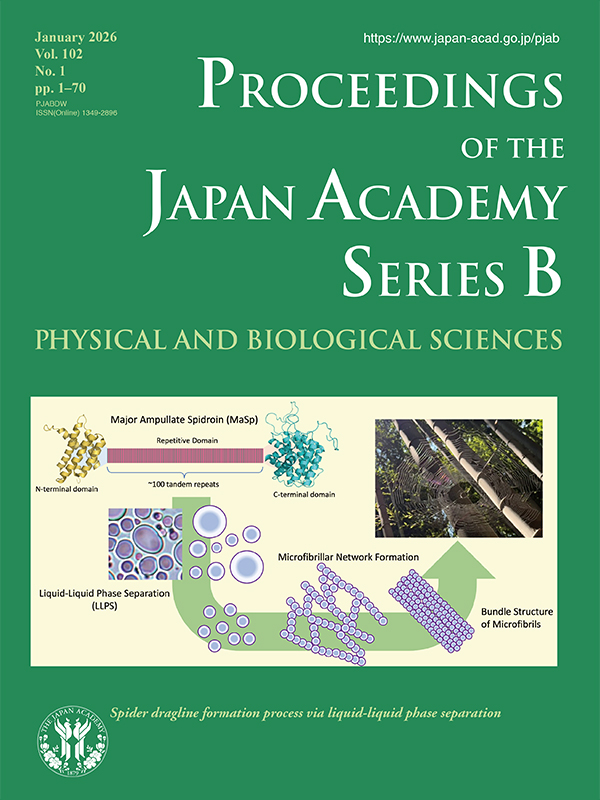
Recently, researchers across diverse fields—including biology, biochemistry, biophysics, analytical chemistry, polymer science, textile technology, and biomaterials—have shown growing interest in spider dragline silk due to its exceptional physical and biological properties. This has prompted intensive efforts to replicate its unique material characteristics and production processes. The Numata group has been particularly active in this area. In their review (pp. 40–56), Numata highlights the structural features of dragline silk and the mechanisms underlying its formation, emphasizing how hierarchical organization supports its outstanding mechanical performance. Schematic illustrations in the review depict the formation of spider dragline silk via liquid–liquid phase separation (LLPS). Upon a decrease in pH, major ampullate spidroins undergo self-assembly to form LLPS droplets. These initial droplets exhibit heterogeneity in diameter, but as the process progresses, they become more homogeneous and begin to develop microfibrillar network structures. These networks act as precursors to microfibril bundles, which eventually assemble under the combined influence of shear forces and dehydration.
Despite its remarkable properties, spider silk remains difficult to replicate, and deeper molecular-level understanding is required for practical applications. The development of non-petroleum, biodegradable materials holds promise for sustainability and reducing microplastic pollution. A key challenge lies in achieving sustainable protein- and polypeptide-based production. Photosynthetic biosynthesis offers potential, but further research into molecular mechanisms and synthetic biology is essential. Applying insights from structural proteins to material design is expected to become increasingly important in the future.
Tetsuo Asakura
Emeritus Professor, Tokyo University of Agriculture and Technology