











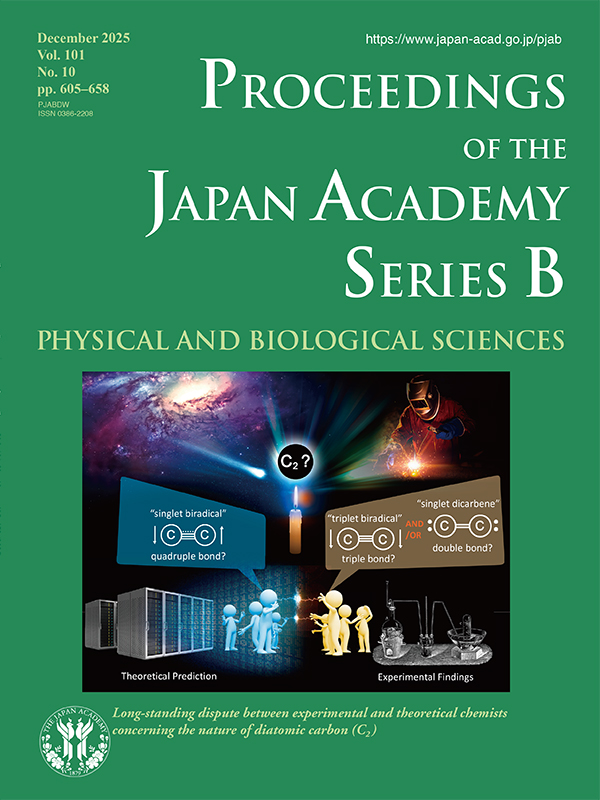
Diatomic carbon (C2) exists in carbon vapor, comets, the stellar atmosphere, and interstellar matter. Although discovered in 1857, it has proved frustratingly difficult to characterize, because C2 gas occurs/exists only at extremely high temperatures (above 3500℃). Since 1930, several experimental methods to generate C2 have been developed using extremely high energy processes, such as electric carbon arc and multiple photon excitation, and the C2 species obtained were reported to exhibit singlet dicarbene and/or triplet biradical behavior. In contrast, recent theoretical simulations suggest that C2 in the ground state should have a quadruple bond with a singlet biradical character. Professors Miyamoto and Uchiyama, the authors of the review article in this issue (pp. 605–621), present the first “bench-top chemical synthesis” of C2 from a hypervalent alkynyl-λ3-iodane in a flask at room temperature or below, providing the first experimental evidence to support theoretical predictions that (1) C2 has a singlet biradical character with a quadruple bond, thus settling a long-standing controversy between experimental and theoretical chemists, and that (2) C2 serves as a molecular element in the bottom-up chemical synthesis of nanocarbons such as graphite, carbon nanotubes, and C60.
Seijiro Matsubara
Professor Emeritus, Kyoto University